
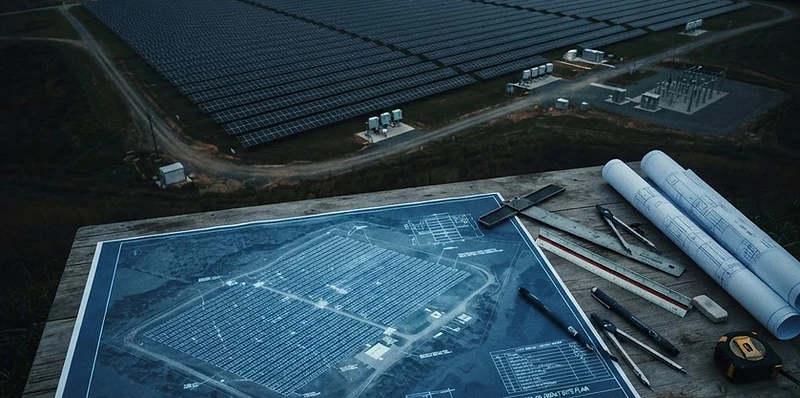
Plan Review — free with your SolarLink signup
A full-scope review of your site, before problems find it first.
We take the site's documents — the inverter history, the build, the red lines, the AHJ and local facility regulations — verify them against what we can see happening to the site, and hand you a maintenance plan that tells you what to repair, and when, to avoid shutdowns, problems, and washouts. Every SolarLink site gets a full Plan Review at no extra cost — the plan is built from your inverter data.
What a Plan Review covers
We read the site's whole history — then tell you what's coming.
Included with your SolarLink signup. One commercial site. One maintenance plan, built on documents, evidence, and data instead of guesswork.
Every document, reviewed
As-builts and red lines, inverter history, permits and AHJ approvals, interconnection docs, O&M records — everything on file about the site goes into one full-scope review.
AHJ & local requirements
Regulations from the Authority Having Jurisdiction and local facility requirements, checked against what was actually built — so nothing is out of compliance that you don't know about.
Depreciation & repair timing
We establish the site's rate of depreciation, when equipment will realistically need repairs, and what to schedule — on time — to avoid shutdowns, problems, and washouts.
AI-verified against physical evidence
Our AI system verifies what was built against everything we can see happening to the site. Physical evidence from SolarCare maintenance reviews shows how the site responds to natural conditions — and how to upgrade or stay proactive.
The result: a full scope on your site with the maintenance and repairs you should schedule — and when — so nothing becomes a shutdown, a washout, or an emergency you didn't see coming.
How it works
Three phases, from a folder of documents to the site's future.
Free with your SolarLink signup — every SolarLink site gets a full Plan Review at no extra cost, because the plan is built from your inverter data. Everything after it — SolarLink, the watch, the work scope — is built on what your own paperwork and production data prove.
Plan Review — free with your SolarLink signup
A desk review of every document on file: the plan set and red lines, bill of materials, manufacturer specs and warranty certificates, permits and AHJ conditions, utility and revenue bills — checked against the manufacturer's spec and the site's own history.
SolarLink + six-month watch
We connect SolarLink monitoring, pull the site's day-one history, and watch the production pattern for six months — with a site visit to verify what the data can't see.
Lifecycle Work Scope
Electrical, mechanical, civil and vegetation scope with a warranty calendar and a reserve plan — and a decision on the site's future: sustain, repower/recommission, or decommission.
Sample data — not a real customer site
Your site's full history, from day one.
Once SolarLink connects to a site, it pulls the inverter's full stored history — back to the day the system was switched on, as far back as its records go. That's the site's whole story: trends, patterns, recurring faults, degradation, and how much revenue it has already left on the table. Below is a sample Lifetime Performance Review for a 1 MW DC community solar site commissioned in 2019.
- Expected
- Actual
589 MWh gap × $0.12/kWh
Typical warranty allowance: 0.5% per year.
Trending slightly above the warranty allowance — documented, year-by-year evidence if a claim is ever needed.
Fault timeline
Patterns found
What eight years of history makes obvious.
Seasonal
Winter snow losses and summer shading repeat on the calendar — schedule clearing and trimming before they hit.
Recurring
The same string failed twice. A one-off repair was the wrong call the first time — now it gets a permanent fix.
Sudden
Storm trips appear as clean step drops — diagnosed from the history in minutes, not months.
Your first SolarLink Report is a Lifetime Performance Review of your site — every year since it was switched on, what it made, what it should have made, and what that gap cost.
The three tests
Every site has to pass three tests.
The analysis proves what kind of maintenance the site really needs — measured three ways.
The bill
What the site actually cost and earns — the bill of materials and the utility and revenue bills. The plan has to pay for itself against real numbers.
The manufacturer's spec
How the equipment was built to perform. We hold the site's output against the datasheet — not against hope.
After the warranty
What breaks and what it costs once coverage ends. The scope schedules those failures before they schedule themselves.
Down to the shrubs.
The work scope covers everything — including the screening shrubs. Expect losses in the first 3 years: landscaper warranties usually cover just 1 year, and towns can require replacement for the life of the system. The scope budgets for it, so the owner isn't surprised by it.
What to have ready
You don't need everything to start.
The 16 Essential items below let us start your Plan Review — the rest make your report sharper. If you don't have something, tell us: your report will show what each gap affects, and we can quote rebuilding key drawings on a site visit.
Battery on site? Add the battery listing and fire-safety documents — UL 9540 listing, 9540A report, hazard mitigation analysis and fire approvals — along with the decommissioning plan and bond.
Sign up for SolarLink + Plan Review
Free with your SolarLink signup.
Tell us about the site and what documents you have available. Every SolarLink site gets a full Plan Review at no extra cost — the plan is built from your inverter data. Commercial sites only.